
How thick should a concrete driveway be in Australia?
October 14, 2026
Residential driveway specifications vary between councils, so there is no single thickness that applies everywhere.
As a general guide:
- Residential driveways: commonly 100 mm to 130 mm
- Commercial driveways: often around 150 mm
- Industrial or heavy-load access: may require thicker slabs and heavier reinforcement
The final thickness should follow the relevant drawings, engineering requirements and local authority standards.
Concrete driveway thickness depends on how the driveway will be used, the condition of the ground underneath, reinforcement, drainage and local council requirements.
For many residential driveways, 100 mm to 130 mm is a common range. Commercial and industrial crossings may require 150 mm or more, depending on vehicle loads and engineering requirements.
What is the typical concrete driveway thickness?
Residential driveway specifications vary between councils, so there is no single thickness that applies everywhere.
As a general guide:
- Residential driveways: commonly 100 mm to 130 mm
- Commercial driveways: often around 150 mm
- Industrial or heavy-load access: may require thicker slabs and heavier reinforcement
The final thickness should follow the relevant drawings, engineering requirements and local authority standards.
What affects driveway thickness?
The main factors include:
- Vehicle loading: Heavier vehicles place more stress on the slab.
- Subgrade condition: Soft or unstable ground may need additional preparation.
- Base preparation: A well-compacted base provides consistent support.
- Reinforcement: Mesh helps control cracking and distribute loads.
- Drainage: Poor drainage can weaken the material beneath the slab.
- Local requirements: Council standards may specify thickness, reinforcement and concrete strength.
Why base preparation matters
Concrete performs best when it has stable support underneath it.
Soft or unsuitable material may need to be removed before the base is placed and compacted. This is particularly important over disturbed ground, filled areas or service trenches.
A thicker slab alone will not compensate for poor ground preparation.
Does a concrete driveway need reinforcement?
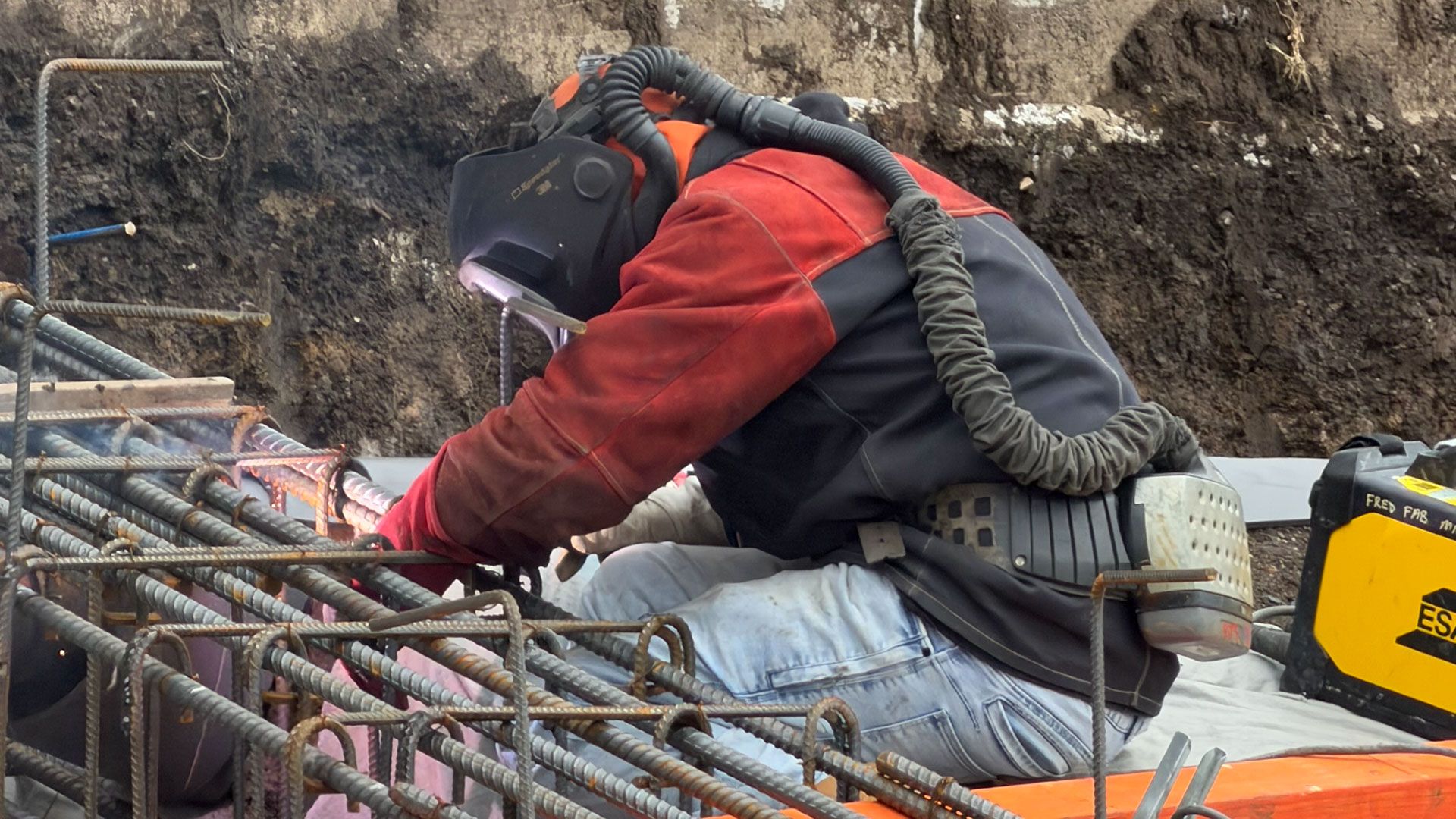
Reinforcing mesh is commonly used in concrete driveways to help control cracking and improve performance under load.
The mesh should also be positioned correctly within the slab using suitable chairs or spacers rather than sitting directly on the ground.
The required reinforcement will depend on the driveway design, expected loading and council or engineering requirements.
Residential vs commercial driveways
Residential driveways generally carry cars, utes and other light vehicles, while commercial and industrial access areas may handle trucks, frequent movements and higher axle loads.
For heavier-duty applications, the design may need to consider:
- thicker concrete
- heavier reinforcement
- concrete strength
- jointing
- drainage
- turning movements
- subgrade conditions
Check council requirements before building
The driveway crossing between the property boundary and road often needs to meet specific council standards.
These may cover:
- slab thickness
- reinforcement
- concrete strength
- driveway grade
- drainage
- kerb and footpath connections
Always check the relevant council drawings and permit requirements before construction begins.
When should a driveway be engineered?
Engineering input may be needed where:
- heavy vehicles will use the driveway
- ground conditions are poor
- there are major level changes
- retaining structures are involved
- the driveway connects with pits, drainage or structural concrete
- the driveway forms part of a larger commercial or civil project
Plan more than just the thickness
Concrete driveway thickness is only one part of a durable result. Base preparation, reinforcement, concrete strength, drainage, jointing and correct placement all matter.
For many residential driveways, 100 mm to 130 mm is a useful starting point, while heavier commercial and industrial access may require 150 mm or more.
If the driveway forms part of a wider civil or structural concrete package, review the site requirements early so the excavation, reinforcement, drainage and concrete works can be coordinated properly.
You can also read our box culvert installation guide for more practical civil construction guidance.
ADDITIONAL BeaRS STORIES